NayAye

From post roads to prompt roads.
Unofficial Office of the Digital Surveyor

In a market flooded with AI “Yes-Men,” NayAye provides the necessary friction. A decision-support engine modeled after the pragmatic, skeptical, and systematic intelligence of Benjamin Franklin — it forces the user to justify their stack before granting the “Aye.”

The Operational Logic Open the App Full Portfolio
Why It Matters

Twelve Years of Physical Logistics.
One Digital Instrument.

Every constraint in NayAye’s architecture — the staged intake, the forced audit, the contingency path — was learned on loading docks, ferry terminals, and rural routes where a single planning failure cascades into systemic disruption. The app is the artifact. The twelve years behind it are the credential.

The Origin
Physical Logistics
Operations
12 years managing route coverage, carrier constraints, contingency planning, and constraint-based decision-making at operational scale. Every plan required a fallback. Every route had to account for failure.
Translates
The Instrument
Digital Infrastructure
Architecture
Systems-level thinking applied to software selection: define the cargo, audit the constraints, chart the most efficient path, map the contingency. The discipline is identical. Only the medium has changed.
Eliminating Software Sprawl
NayAye reduces “Choice Paralysis” and the accumulation of redundant, overlapping tools. The audit stage identifies over-engineered paths before the user commits resources — the same discipline applied to managing route coverage and carrier assignments at scale.
Cost-Conscious by Design
The Budget constraint in Stage 1 is not a filter — it is a forcing function. The engine actively identifies free and low-cost alternatives for small-scale operations, ensuring recommendations are proportionate to actual operational scale.
Systems Thinking, Applied
The three-stage workflow — Intake, Audit, Route — mirrors any well-run logistics operation: define the cargo, identify the constraints, chart the most efficient path. NayAye demonstrates that this discipline is not industry-specific. It is transferable.
Contingency as Standard Practice
The Contingency Path is not an afterthought. It reflects a professional standard developed over 12 years managing operations where a broken scanner, a missed ferry, or a route gap cascades into systemic failure. Every plan needs a fallback.
The Core Philosophy

The Necessary Friction.

Most AI tools are designed to agree with you. They accelerate decisions without questioning whether those decisions are correct, cost-effective, or even necessary. The result is software sprawl, redundant subscriptions, and choice paralysis masquerading as productivity.

NayAye is built on the opposite premise. Before any recommendation is made, the engine audits the user’s intent, identifies operational waste, and surfaces the friction points that most tools are incentivized to ignore. Only after the “Nay” is addressed does the “Aye” get granted.

“An investment in knowledge pays the best interest.”

— Benjamin Franklin, the model for NayAye’s decision logic
The Functional Workflow — Blueprint Schematic

Survey & Route: Three Stages.

NayAye operates on a three-stage “Survey & Route” logic. Each stage is sequential and deliberate — the engine will not advance to a recommendation until the prior stage is resolved. This is not a suggestion pipeline. It is a deterministic workflow.

Stage 01
Intake
The Inquiry
Define the Cargo before charting the route.
User inputs a goal and defines their operational constraints: Budget, Technical Skill Level, and Privacy Requirements. The engine accepts no ambiguity at this stage.
InputGoal + Constraints
OutputConstraint Set
NayAye — Intake Module
Lock
Stage 02
Audit
The Nay
The Ben Franklin Reality Check.
Before any tool is suggested, the engine identifies Operational Waste: over-engineered paths, redundant costs, and privacy risks. The engine challenges the premise before it validates the plan. No other AI tool in this category is designed to push back first.
InputConstraint Set
OutputWaste Report
NayAye — Audit Module
Clear
Stage 03
Route
The Aye
Primary route and contingency path, both mapped.
Only after the Nay is addressed does the engine provide a Primary tool recommendation and a Backup Contingency Plan. Dual-path output is a direct translation of logistics-grade planning discipline into digital infrastructure — every route needs a fallback.
Output APrimary Route
Output BContingency
NayAye — Route Module
Legend
Sequential Logic Gate
Approved Output
Constraint Boundary
MJH-III — NayAye Workflow v1.0
Key Features & Deliverables

Three Artifacts. One Survey.

When the survey is complete, the user receives three distinct deliverables. Each is designed to be immediately actionable — not a list of options, but a structured decision package.

The Verdict
A witty, contrarian assessment of the user’s current plan. Written in NayAye’s signature 18th-century voice, it identifies the specific inefficiencies in the user’s proposed approach before any recommendation is made.
The B.Free Map
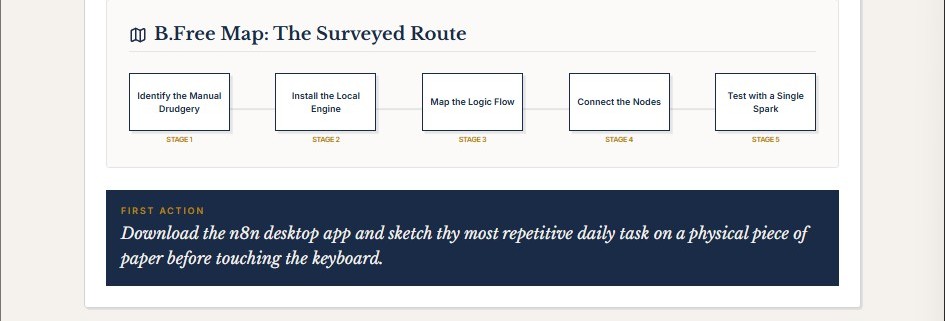
A visual “Route Flow” — called The Prompt Road — showing exactly how to connect the recommended tools in sequence. Not a suggestion list. A map.
The Contingency Path
A secondary tool recommendation in case the primary “Bridge” fails. A direct translation of logistics contingency planning into digital infrastructure decision-making.
Technical Architecture

The Stack Behind the Surveyor.

NayAye is built to demonstrate systems-level thinking across the full stack — from AI logic engine to UI/UX to data structure. Each component was selected deliberately to serve the product’s core function. The architecture is designed to eliminate hallucination at the recommendation layer by making AI responsible only for language, not for routing logic.

Logic Engine
Gemini 1.5 Flash
High-speed, long-context reasoning selected for its ability to hold the full survey context across all three stages without truncation or drift.
System Persona
Custom Chain-of-Thought Prompt
A custom-engineered system prompt utilizing Chain-of-Thought (CoT) reasoning to maintain the Sovereign/18th-century tone without sacrificing modern technical accuracy.
UI / UX
React — Hosted on Vercel
A minimalist React-based interface designed for mobile-first “one-screen” utility. The entire workflow completes within a single viewport — no navigation required.
Data Structure
JSON Tool Libraries
JSON-based tool libraries map user constraints (Budget and Skill Level) to specific software capabilities, enabling deterministic routing logic beneath the AI layer.
Deterministic Architecture — Design Note

The routing logic in NayAye is not generated by the AI. Tool recommendations are drawn from structured JSON libraries that map user constraints to pre-validated software options. The AI is responsible for language, tone, and audit reasoning — it is deliberately constrained from hallucinating tool recommendations by the data layer beneath it. This separation of concerns — deterministic routing beneath a generative voice layer — is the core architectural decision. It is not accidental. It reflects a logistics operator’s instinct to never let the narrator choose the route.

The App in Action

The Survey in Session.

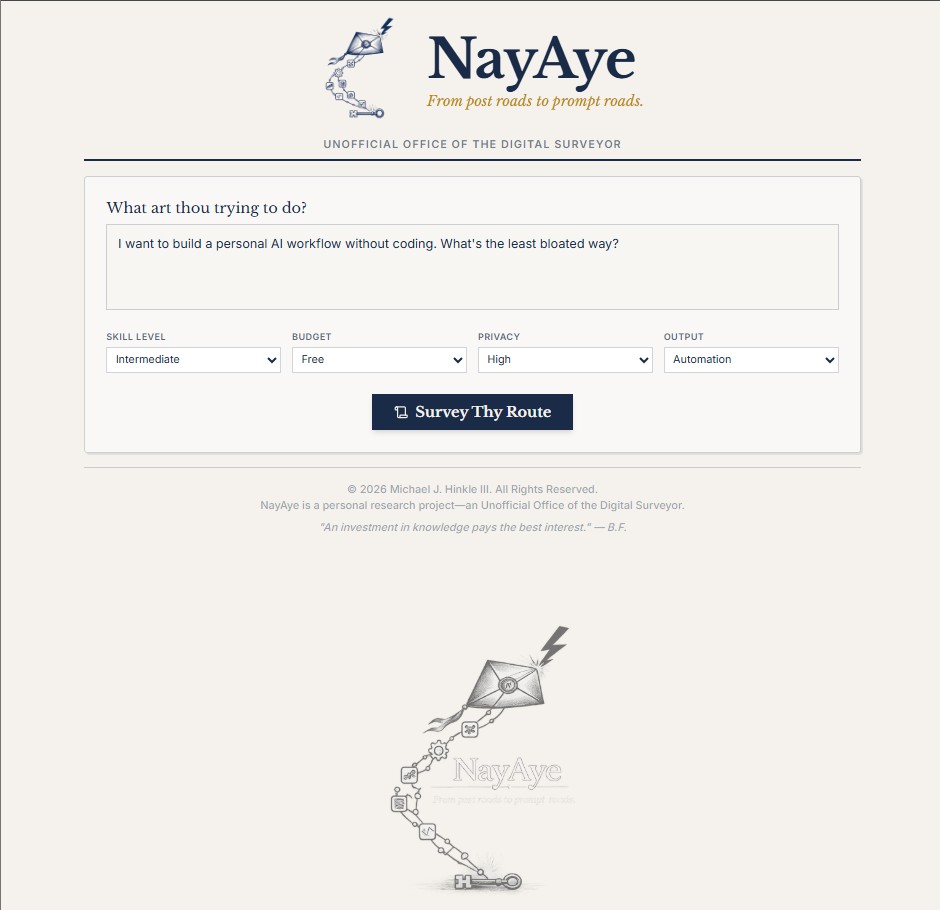
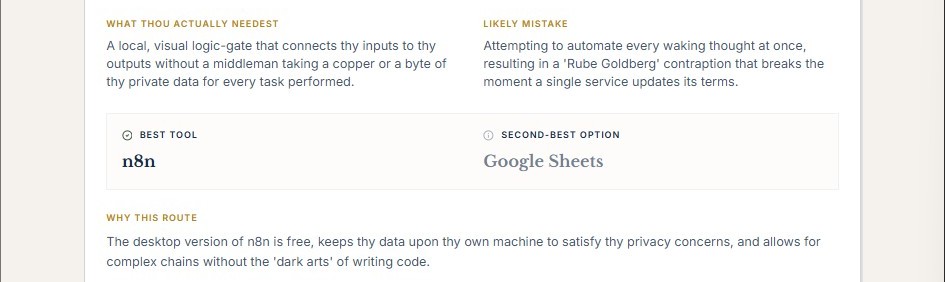
The following screens show a complete NayAye session from intake through verdict. The interface is intentionally sparse — the friction is in the logic, not the UI.

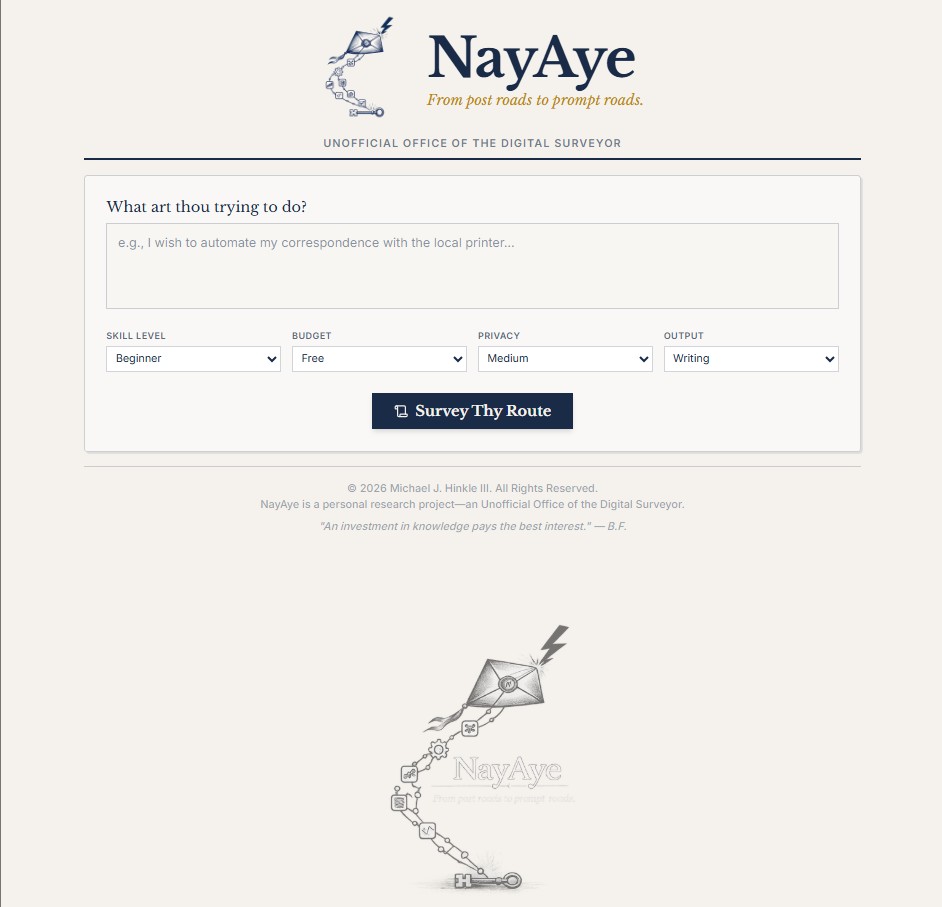
NayAye home screen
The Intake Form
NayAye question 1
Stage 1 — Question 1
NayAye answer 1
Stage 2 — The Nay
NayAye question 2
Stage 1 — Question 2
NayAye answer 2
Stage 3 — The Aye
NayAye question 3
The B.Free Map
Try It. Challenge It.

The Surveyor is open for business.

NayAye is live and free to use. Survey thy route — and see if your stack survives the audit.

Open NayAye Connect on LinkedIn